|
[Index] DISCLAIMER:The information in this circular relating
to the legal requirements of specific foreign countries is provided for general
information only and may not be totally accurate in a particular case. Questions
involving interpretation of specific foreign laws should be addressed to foreign
legal counsel. The information is based on the Implementation Measures on the
Adoption of Children by Foreigners in the People's Republic of China of November 13,
1993 and the China Adoption Law of April 1, 1992.
PLEASE NOTE:Chinese authorities are extremely
sensitive about the intrusion of foreign entities. Adoption is also a sensitive
subject in China. It is therefore advisable for any person interested in adopting
a child from China to act with discretion and decorum. High profile attention to
adoption in China could curtail or eliminate altogether adoption of Chinese children
by persons from countries that have caused adoption to become the subject of public
attention.
Only adoptions fully completed in China are permitted. It is not possible to obtain
guardianship of a Chinese child for adoption in the United States. The China
Adoption Law has specific provisions as to what children are available for adoption
and what adoptive parents are acceptable. These variables will be discussed in the
flyer.
Prospective adoptive parents are advised to fully research any adoption agency or
facilitator they plan to use for adoption services. For U.S. based agencies, it is
suggested that prospective adoptive parents contact the Better Business Bureau and
licensing office of the Department of Health and Family Services in the state where
the agency is located.
GENERAL: The following is a guide for U.S. citizens
who are interested in adopting a child in China and applying for an immigrant visa
for the child to come to the United States. This process can be expensive,
time-consuming and difficult, involving complex Chinese and U.S. legal requirements.
Adoptions are given careful consideration on a case-by-case basis by both Chinese
authorities and American consular officers to ensure that the legal requirements of
both countries have been met, for the protection of the prospective adoptive parent
(s), the biological parents(s) and the child. Interested U.S. citizens are strongly
encouraged to contact U.S. consular officials in Guangzhou and Beijing before
formalizing an adoption agreement to ensure that appropriate procedures have been
followed which will make it possible for the Embassy (Consulate) to issue a U.S.
immigrant visa for the child.
[Index] AVAILABILITY OF CHILDREN FOR ADOPTION: Only children
processed by China's central authority for international adoptions, the Chinese
center for Adoption Affairs (CCAA) are available for international adoption. The
CCAA matches individual children with prospective adoptive parent(s) whose
completed applications have been submitted to the CCAA by a licensed U.S. adoption
agency whose credentials are on file at the CCAA.
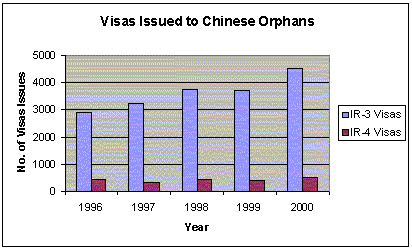
Recent U.S. immigrant visa statistics reflect the following pattern for visa
issuance to orphans:
FY-1996 IR-3 immigrant visas issued to Chinese orphans adopted abroad - 2, 901
IR-4 immigrant visas issued to Chinese orphans adopted in the U.S. - 432
FY-1997: IR-3 Visas - 3, 242, IR-4 Visas - 355
FY-1998: IR-3 Visas - 3, 766, IR-4 Visas - 440
FY-1999: IR-3 Visas - 3, 688, IR-4 Visas - 413
FY-2000: IR-3 Visas - 4, 520, IR-4 Visas - 533
[Index] CHINA ADOPTION AUTHORITY: The government office
responsible for adoptions in China is the Ministry of Civil Affairs, specifically
the CCAA.
[Index] CHINA ADOPTION PROCEDURES:
An agency may submit adoption applications directly to the CCAA for consideration.
Included with the application should be all the required documents (you'll find the
list in documentary requirements) with authentications and translations. In
addition, each application should indicate any preference for a healthy or
handicapped child, preferred age and sex of the child, and, if desired, a specific
Welfare Institute or geographic area of China in which you are interested. The CCAA
will review the documents and advise the prospective adoptive parent(s) directly
or through their U.S. licensed adoption agency, whether additional documents or
authentication required.
Once the application for adoption is approved, the CCAA will then match the
application with a child whose paperwork has been forwarded to the CCAA by a
provincial Civil Affairs Bureau. Once a child is identified, the CCAA will send a
letter of introduction about the child, photographs and a health record of the
child through the U.S. adoption agency to the prospective adoptive parent(s).
Questions about the child not answered in the material provided by the Chinese
authorities may be relayed through your U.S. licensed adoption agency or by you
directly to the CCAA.
To finalize the adoption, the prospective adoptive parent(s) need to travel to
China to complete the process. It is important to contact the U.S. Bureau of
Citizenship and Immigration Services in the Department of Homeland Security early
in the process; you must have an approved I-600A before proceeding to China.
After the CCAA has advised you or your U.S. adoption agency in writing that your
application is initially accepted for the adoption of a specified child, you may
then respond through your adoption agency that you are interested in finalizing
the adoption of the specified child. After indicating your acceptance of the child,
you will then receive a formal notice from the CCAA to proceed to China. When the
CCAA issues an approval notice ("Notice of Coming to China for Adoption"), this
notice will bear the "chops," or red-inked seals of the CCAA. Prospective parents
should have this approval notice in hand before departing for China. With approval
notice in hand, prospective parents may then proceed directly to the city in China
where the Civil Affairs Bureau with jurisdiction over the appropriate Children's
Welfare Institute is located. Thereafter, a series of interviews of the prospective
adoptive parent(s) will occur; a contract will be signed with the Children's
Welfare Institute; the contract will be registered with the Civil Affairs Bureau;
and a notarized adoption decree will be issued.
Parents will not be required to travel to Beijing for approval. The CCAA will have
already forwarded a copy of the adoption approval notice to the locality where the
child resides. Local Chinese Child Welfare Institutes, Provincial Chinese Civil
Affairs officials and Chinese notarial offices will not process adoptions unless
they have seen this notice. Thus any parents already in China without the approval
notice will be required to obtain one from the CCAA in Beijing before the adoption
process can be completed.
Americans adopting in China commonly meet with a notary in the provincial capital
for an informal interview. A Chinese notary is not comparable to a notary public
in the United States, but rather is an official with broad responsibilities. A
translator supplied by the Child Welfare Institute is usually present. Meetings
are held in the notary's office in a non courtroom-like setting. Common questions
asked of the prospective adoptive parent(s) include: Why are you adopting a Chinese
child? Do you have any children now (either adopted or birth)? What is your family
background? Why do you not have children? How can you assure us that the adopted
child will be well treated?
In some cases a second interview at a registry office is conducted. Sometimes
prospective adoptive parent(s) are asked to write a paragraph or a page on the
reasons for the adoption and their plans for the child. Sometimes the local notary
in the city where the Children's Welfare Institute is located, meets with the
parents and conducts a final interview in which questions similar to those posed
at the provincial level are asked. Parents recently going through the process were
told that Beijing's approval had been sought and obtained for their adoptions,
in accordance with the procedures of the CCAA.
Prospective adoptive parents may request to see the child before completing the
adoption. Any remaining questions and concerning the child's state of health or
personal background after seeing the child should be addressed before completing
the adoption. Prospective adoptive parents may wish to have the child examined by
a physician on the U.S. Embassy or Consulate's list of physicians before finalizing
the adoption. It will probably not be possible under Chinese procedures for the
prospective adoptive parents to take the child to a hospital in a city distant from
the child's location for examination. Before the adoption is finalized, the
prospective adoptive parents have no legal custody or guardianship of the child,
and may not be allowed by Chinese authorities to take the child anywhere.
After all interviews are completed, the actual adoption and completion of the
contract, which includes making a fixed "donation" of around $3000-$4000 US dollars
to the Children's Welfare Institute, take place. This "donation" is NOT a bribe,
but is required for the adoption and completion of contract for the institute.
Prospective adoptive parents will be requested to sign an adoption agreement/
contract with the welfare institute, then register the adoption at the provincial
Civil Affairs Bureau, pay requisite Chinese fees and obtain a Chinese passport and
exit permit for the child. The adoption process also includes signing an agreement
with the person or institution putting up the child for adoption, registering in
person with the Chinese Civil Affairs Bureau and carrying out the notarized
procedures at the designated Chinese notarial office. When the notarial office in
the child's place of residence approves the adoption, that office issues a
notarized certificate of adoption, a notarized birth certificate and either
notarized death certificate (s) for the child's biological parent(s) or a statement
of abandonment from the welfare institute. The adoptive relationship goes into
effect on the day of the notarization.
Once the adoption is final, the adoptive parents are responsible for the child. If
the adoptive parents change their minds about the adoption after it is final, but
before removing the child from China, the child may no longer be considered an
orphan by Chinese authorities. As such, the child may not be eligible for medical
service or educational benefits in China unless the adoptive parents formally
notify the CCAA that they are relinquishing the child in a statement which is
notarized by the appropriate local Chinese authorities. It should also be noted
that such action might impede future adoption in China by the particular adoptive
parents. Under no circumstances is it appropriate for adoptive parent(s) who have
returned to the United States with a child, who enters the U.S. as a permanent
resident alien, to simply return the child to China if they cannot keep the child.
Rather, parents should contact their adoption agency or their state social services
office for assistance.
[Index] AGE AND CIVIL STATUS REQUIREMENTS: Chinese law
differentiates between an abandoned child (with one or both parents living) and an
orphan (both parents deceased). The law restricts adoption of healthy abandoned
children with one or both parents living to childless person 35 years old or older,
and only permits the adoption of one healthy child. There are exceptions if you are
adopting a relative's child. Persons who are under 35 years old and/ or who already
have child (ren) are only permitted to adopt orphans (requiring proof that both
biological parents are deceased) or handicapped children. Persons seeking to adopt
orphans or handicapped children are permitted by Chinese law to adopt more than one
such child. The Chinese law permits adoption by married couples and single persons.
The CCAA also has advised that "adoption applications from homosexual families are
not acceptable."
The Adoption Law of the People's Republic of China adopted by the 23rd meeting of
the seventh National People's Congress Standing Committee on December 29, 1991
(effective April 1, 1992) provides that, with certain exceptions, children under
the age of 14 in the following categories may be adopted:
- Orphans who lost their parents
- Abandoned children whose birth parents cannot be found
- Children whose birth parents are incapable of providing for them because of
unusual hardship.
Restriction on age of adopting parent(s) and restriction on adopting more than one
child may be waived when: 1) the children being adopted are blood relatives of the
adopting parent(s), 2) the children being adopted are orphans, or 3) the children
are handicapped.
All requests to adopt more than one child are given special consideration by the
Chinese authorities and processed on a case-by-case basis. In cases involving the
adoption of more than one child, Chinese authorities look carefully at the age of
other child (ren) in the home, nature of handicap involved (if any), age and health
of the adoptive parent(s), adoptive parent(s)' physical and emotional ability to
care for two or more children, financial ability to raise more than one child.
[Index] RESIDENCY REQUIREMENTS: The adoptive parent(s) must
come to China to execute the required documents in person before the appropriate
Chinese authorities to finalize the adoption. If the adoptive parent is married, he
or she should adopt the child together with the spouse. In case of married couples,
if only one adopting parent comes to China, Chinese law requires that the spouse
traveling to China bring a power of attorney from his or her spouse which has been
notarized and properly authenticated by the Chinese Embassy or one of the Chinese
Consulate Generals in the United States. In addition to documents required by the
Chinese Government, the American Consulate in Guangzhou advises that if only one
parent is coming to China to adopt a child with a physical or mental disability, a
notarized statement from the absent parent indicating that they are aware of the
child's disability and intends to finalize the adoption in the United States, is
required under U.S. law.
[Index] ADOPTION AGENCIES AND ATTORNEYS: The U.S. Bureau of
Citizenship and Immigration Services in the Department of Homeland Security does
not allow the use of powers of attorney for the purpose of signing the I-600
Petition to classify an orphan as an Immediate Relative. Responsibility for various
procedures necessary to adopt a child in China in accordance with Chinese law is
divided among the following Chinese government authorities:
The China Center for Adoption Affairs (CCAA)
103 Beiheyan St.
Dongcheng District
Beijing 100006
Phone: 86-10-6522-3102
86-10-6513-0607
Department of Civil Affairs
No. 147 Beiheyan St.
Beijing, 100032
China
Children's Welfare Institutes- is administered by the Ministry of Civil Affairs
through provincial Civil Affairs Bureaus. These are government-operated homes for
orphaned or abandoned children. Children can only be placed in the welfare
institutes if their parents have died or abandoned them. In cases of abandoned
children, the authorities attempt to locate the children's biological parents
before allowing them to be adopted from the institutes.
Notarial Offices- the Provincial Notarial Offices, which are administered by the
ministry of Justice, Department of Notarization Division (No. 10 Chaoyangmen
Nandajie, Beijing 100020 China) issue the final adoption certificate. That process
terminates parental rights of the birth parent(s). Each adoption certificate is
accompanied by a notarial birth certificate for the child and either a statement
explaining the circumstances of abandonment for abandoned children or notarial
death certificates of the orphaned child's parents.
Public Security Bureau- the Public Security Bureau in the locality where the
adoption takes place is responsible for issuing Chinese passports and exit permits
to children adopted by foreigners.
[Index] DOCTORS: The U.S. Embassy in Beijing and the
Consulate Generals all maintain current lists of doctors and sources for some
western medicines, should either you or your child experience health problems
while in China.
A physician from an approved list of doctors ("panel physicians") using a specified
form provided must perform the medical examination that the adoptive child needs,
by the American Embassy or Consulate. The medical examination can be performed in
Beijing, Shanghai, Guangzhou, or Taishan. The most convenient site for medical
examinations in Guangzhou is the: Guangzhou Health and Quarantine Service, a modest
walk from the Consulate at 33 Shamian North Road, telephone: 020-8188-9513.
[Index] CHINA DOCUMENTARY REQUIREMENTS: A foreigner
interested in adopting a Chinese child must submit the following documents to the
China Center of Adoption Affairs. It is advisable to bring several copies of the
authenticated documentation with you to China.
- Adoption application
- Birth certificate
- Marital status certificate
- Certificates of profession, income and property
- Health examination certificate
- Certificate of criminal or no-criminal record
- Home study report
- Certificate of child adoption approval by the competent department of the adopter's country of residence
- Copy of applicant's passport
- Two full-faced photos and several other photos reflecting the family's life
In addition to the package of documents forwarded by your adoption agency to the
CCAA for approval, you are also required to have a chain of certificates and
approval.
- Certified and authenticated copies of the adoptive parent(s)' birth certificate(s)
- Certified and authenticated copy of the adoptive parents' marriage certificate and proof of termination of any previous marriage (certified copy of spouse's death certificate of divorce decree)
- Medical certificate(s) for adoptive parent(s) executed by physician before a notary public and authenticated
- Statement that adoptive parent(s) is/are childless and has/have not adopted other children (notarized and authenticated)
- A medical certificate of infertility if that condition exist (executed by a physician before a notary public and authenticated). (Note: Infertility is no longer a requirement for adoption in China).
- A certificate of good conduct for the adoptive parent(s) from a local police department notarized or bearing the police department-seal and authenticated. An FBI report is acceptable in lieu of a local police record. This is separate from the FBI check conducted by BCIS as part of the petition process. You can request an FBI record check by sending two sets of fingerprints, an $18.00 money order, your full name, date and place of birth, social security number and letter of request explaining purpose for clearance to: FBI ID Division, Room 10104, Washington, DC 20537-9700. The FBI certificate should also be authenticated.
- Verification of employment and salary notarized and authenticated.
- Two letters of reference notarized and authenticated
- A certified and authenticated copy of your property trust deeds, if applicable
- A home study prepared by an authorized and licensed social agency certified and authenticated
- Bank statements notarized/certified and authenticated
- Power of attorney notarized and authenticated (if only one spouse will travel to China). In case of married couples, if only one adopting parent comes to china, Chinese law requires that the spouse traveling to China, bring a power of attorney from his or her spouse which has been notarized and properly authenticated by Chinese Embassy or one of the Chinese Consulate General in the United States.
- Family letter of intent to adopt, describing the child the adoptive parent(s) is/are willing to adopt, notarized and authenticated
- A copy of the I-171H form (approval notice from BCIS) notarized and authenticated.
[Index] TRANSLATION REQUIREMENTS: All documents prepared for
each adoption application must be accompanied by a certified Mandarin Chinese
translation. For a $200 fee, the CCAA will provide the translation service. If a
translated copy is submitted with the application, the translator must execute a
statement before a notary public as to the validity of the translation. The notary's
seal must be authenticated.
[Index] AUTHENTICATION REQUIREMENTS: All foreign (U.S.)
documents must be authenticated for use in China. Keep in mind that the purpose of
having documents authenticated is to verify their contents and validity of the
issuing authority. Some documents have been rejected because the seals they bore
did not serve purpose. For example, if the translator's affidavit only confirms
the identity and signature of the translator, but does not attest to the validity
of the translation, this is insufficient under Chinese law. Likewise, a notary
public cannot legally certify the contents of a civil document, such as a birth or
marriage record. A notarized certified true copy is not an authenticated copy of a
civil record. A certified copy must be obtained from the bureau of vital statistics,
which maintains the original record.
Generally, U.S. civil records, such as birth, death, and marriage certificates must
bear the seal of the issuing office. Then it must be authenticated by the state's
Secretary of State in your state capital, then by the U.S. Department of State
Authentication's office and then by the Chinese Embassy or Consulate in the United
States. Check with the Chinese Consulate in the U.S. with jurisdiction over your
state to see what seals and signatures the Consulate can authenticate. It may be
possible to eliminate some of the steps if the Consulate has the seal of the local
issuing authority on file.
Tax returns, medical reports and police clearances should likewise be authenticated,
beginning with the seal of notary public in the United States or some appropriate
issuing office. The notary's seal should be authenticated by the county clerk where
the notary is licensed or some similar authority. The document should then be
authenticated by the state Secretary of State; (in your state capital) the U.S.
Department of State Authentication's Office, and the Chinese Embassy or Consulate.
[Index] U.S. IMMIGRATION REQUIREMENTS
A Chinese child adopted by an American citizen must obtain an immigrant visa before
he or she can enter the U.S. as a lawful permanent resident. There are two distinct
categories of immigrant visas available to children adopted by American citizens.
A Previously Adopted Child. Section 101(b)(1)(E) of the U.S. Immigration and
Nationality Act defines an "adopted child" as one who was adopted under the age of
16 and who has already resided with, and in the legal custody of, the adoptive
parent for at least two years. Parents who can demonstrate that their adopted child
meets this requirement may file an I-130 petition with the U.S. Bureau of
Citizenship and Immigration Services in the Department of Homeland Security (BCIS)
having jurisdiction over their place of residence in the United States. Upon
approval of the I-130 petition, the parents may apply for an immigrant visa for the
child at the U.S. Embassy in Beijing. American citizens who believe this category
may apply to their adopted child should contact the U.S. Embassy in Beijing for
more information.
An Orphan. If an adopted child has not resided with the adoptive parent for two
years (or if the child has not yet even been adopted) the child must qualify under
section 101(b)(1)(F) of the U.S. Immigration and Nationality Act in order to apply
for an immigrant visa. The main requirements of this section are as follows:
- The adoptive or prospective adoptive parent must be an American citizen;
- The child must be under the age of 161 at the time an I-600 Petition is filed with the BCIS on his or her behalf;
- If the adoptive or prospective adoptive parent is married, his or her spouse must also be a party to the adoption;
- If the adoptive or prospective adoptive parent is single, he or she must be at least 25 years of age;
- The child must be an orphan, as defined by U.S. regulations. Although the definition of an orphan found in many dictionaries is "A child whose parents are dead," U.S. immigration law and regulations provide for a somewhat broader definition. Children who do not qualify under this definition, however, may not immigrate to the U.S. as an orphan even if legally adopted by an American Citizen. The Department of State encourages Americans to consider if a particular child is an orphan according to U.S. immigration law and regulations before proceeding with an adoption. A detailed description of the orphan definition used by BCIS can be found on BCIS's web site at http://www.immigration.gov
[Index] U.S. IMMIGRATION PROCEDURES FOR ORPHANS
I. The Petition.
Adoptive and prospective adoptive parents must obtain approval of
a Petition to Classify Orphan as an Immediate Relative (Form I-600) from the U.S.
Bureau of Citizenship and Immigration Services in the Department of Homeland
Security (BCIS) before they can apply for an immigrant visa on behalf of an orphan.
The adjudication of such petitions can be very time-consuming and parents are
encouraged to begin the process well in advance.
A prospective adoptive parent may file Form I-600A Application for Advance
Processing of Orphan Petition with the Bureau of Citizenship and Immigration
Services in the Department of Homeland Security (BCIS) office having jurisdiction
over their place of residence. This form allows the most time-consuming part of the
process to be completed in advance, even before the parent has located a child to
adopt. In addition, a parent who has an approved I-600A may file an I-600 in person
at the U.S. Embassy in Beijing.
Detailed information about filing these forms can be found on BCIS's web site at
http://www.immigration.gov. Americans who
have adopted or hope to adopt a child from China should request, at the time they
file these forms, that BCIS notify the U.S. Embassy in Beijing as soon as the form
is approved. Upon receipt of such notification, the Embassy will contact the
parents and provide additional instructions on the immigration process. U.S.
consular officers may not begin processing an orphan adoption case until they have
received formal notification of approval from an BCIS office in the US.
II. The Orphan Investigation
One part of the petition process that BCIS cannot complete in advance is the
"orphan investigation". An orphan investigation Form I-604 Report on Overseas
Orphan Investigation) is required in all orphan adoption cases - even if an I-600
has already been approved - and serves to verify that the child is an orphan as
defined by US immigration law. This investigation is performed by a consular
officer at the time of the child's immigrant visa interview.
[Index] WORKING WITH THE U.S. CONSUALTE ON THE VISA:
Under the U.S. Immigration and Nationality Act (INA), consular officers can only
adjudicate approvable I-600 petitions. If there are any questions regarding the
eligibility for orphan status or whether petition conditions have been met,
consular officers must refer these petitions to the BCIS office in Guangzhou. When
an orphan petition (I-600) is sent to an American embassy or consulate for possible
issuance of an immigrant visa (form OF-230) to the child, or when an orphan petition
is filed at an American embassy or consulate, a consular officer does an overseas
orphan investigation as part of the normal processing. This is usually done very
quickly. However, the investigation and visa processing can sometimes be lengthy,
especially when adoptive parents employ irregular practices to adopt a child, making
the petition "not clearly approvable." BCIS form I-604, Request for and Report on
Overseas Orphan Investigation is used by BCIS and consular officers.
When the Chinese notarized formalities are completed, the BCIS petition to Classify
an Orphan as an Immediate Relative (I-600) may be filed for the child at BCIS
Beijing, BCIS Guangzhou, or any of the U.S. Consulate generals in Chengdu, Shanghai,
or Shenyang for forwarding to the Consulate general in Guangzhou, or any BCIS
office. While all U.S. Foreign Service posts in China may adjudicate I-600 forms,
it is advisable to do so in Guangzhou. Since all immigrant visas in China are issued
at the Consulate General in Guangzhou, petitions filed at other posts will be sent
to Guangzhou for processing. It is generally much faster for those adopting parents
who wish to return to the U.S. immediately with the child to file petition at the
Consulate General in Guangzhou.
When the petition is filed at the Embassy or a Consulate, the petitioner (or at
least one of the members of a married adoptive couple) and the child must be
physically present in the consular district. The I-600 is filed by one person but
if the petitioner is married, the petitioner's spouse must also sign the petition.
Both parties must sign the I-600 after the child has been identified and seen by at
least one parent. This means that if one party has gone abroad to arrange the
adoption, the spouse abroad must send the I-600 to the spouse in the United States
(generally by express courier) with the child's identity information completed. The
original signature of both spouses must appear, reflecting their informed
concurrence in the process. BCIS suggests that the traveling spouse leave the
original I-600 with the spouse in the U.S., fax the information after the adoption,
to the spouse in China by international courier. If the petitioner is married and
his or her spouse has not seen the child before or during the adoption proceedings,
then the child must be readopted in the U.S. To do this, the petitioner must show
he or she has met state pre-adoption requirements. BCIS makes this determination at
the time the I-600A is filed or it must be established that pre-adoption
requirements have been met at the time of filing the I-600 at the embassy or
consulate.
If BCIS has already approved an I-600A advanced processing petition, the I-600
petition may be filed and adjudicated at the embassy or consulate to which the
I-600A was sent. If advanced approval has not yet been granted, the I-600 petition
must be forwarded to the BCIS for adjudication. If so, as noted above, a home study
and fingerprinting of parent(s) and any state pre-adoption requirements will be
necessary, perhaps requiring several months to complete. It should be noted again
that the power of attorney is not accepted by BCIS, and both spouses must sign the
I-600 form.
Before departing the U.S., the U.S. Consulate General in Guangzhou strongly advises
adoption agencies and/or adoptive parent(s) to set an appointment for the immigrant
visa interview, and not make final travel plans until the appointment has been
confirmed in writing. Appointments are scheduled on a first-come, first-serve basis,
Monday through Thursday beginning at 9:00am. *Due to increased demand, it is no
longer possible to obtain same-day visa issuance; instead, visas are generally
available the following afternoon*. A parent(s) proceeding to China to complete the
adoption process should plan on three to four days in Guangzhou to complete their
child's medical exam and immigrant visa processing. The Consulate general cannot
guarantee issuance of the visa in advance of the interview.
[Index] DOCUMENTS NEEDED TO BRING WITH YOU TO THE U.S. CONSULATE:
For the immigrant visa application, the child will need:
- A valid PRC passport and exit permit
- A medical examination
- Two 1 ¾ inch color visa photos
- Form I-864, affidavit of support from the prospective adoptive parent(s) and supporting documentation
- The Chinese notarized documentation
[Index] AMERICAN EMBASSY/CONSULATE GENERAL ASSISTANCE: Upon
arrival in China, prospective adoptive parent(s) should register at the Consular
Section, American Citizens Services Section of the American Embassy or Consulate
General. The Embassy/ Consulate general will be able to provide information about
any outstanding travel advisories, any recent changes in adoption procedures and
to provide other information about China including lists of physicians, attorneys,
interpreters and translators.
CHINESE EMBASSY (and Consulates) IN THE UNITED STATES:
Embassy of the People's Republic of China
Consular Section
2300 Connecticut Ave., NW
Washington, DC 20008
Tel: 202-328-2500
China also has Consulates in Los Angeles, CA; San Francisco, CA; Chicago, IL;
New York, NY, and Houston, TX.
U.S. EMBASSY (and Consulate) IN CHINA:
Street Address Mailing Address
U.S. Embassy of China U.S. Embassy Beijing
American Citizen Services American Citizen Services
2 Xiu Shui Dong Jie PSC 461, Box 50
Beijing 100600 PRC FPO AP 96521-0002
Tel: 86-10-6532-3831 ext. 229
Fax: 86-10-6532-4153
China also has Consulates in Guangzhou, Shanghai, Shenyang, and Chengdu.
[Index] APPLYING FOR A CHINESE PASSPORT FOR THE CHILD:
Welfare Institute officials apply for the child's passport and exit permit in the
provincial capital. The adopting parent(s) rarely have had to take care of the
paperwork or visit the Ministry of Justice offices in this regard. The local Public
Security Bureau will normally expedite Chinese passport issuance for a stated fee.
[Index] APPLYING FOR U.S. CITIZENSHIP FOR AN ADOPTED CHILD:
Contact the BCIS for further proof of U.S. Citizenship and how to adjust the status
of the adopted child.
[Index] TIME FRAME: It is hard to predict with certainty how
much time is required to complete an adoption in China. As of the publication of
this flyer, adoptions were taking approximately ten to twelve months from the time
the U.S. adoption agency submitted the paperwork of the prospective adopter to CCAA
to the time the initial referral was sent by CCAA to the prospective parent(s) via
their adoption agency. Special needs cases were taking longer. After the referral
is sent and the prospective parent(s) accept the child, a period of four to eight
weeks elapses before final approval to travel to China is given by CCAA to the
parent(s). With regard to time required in China, once initial approval has been
granted and adoptive parent(s) travel to China to finalize an adoption, the CCAA
has advised local Welfare Institutes and Civil Affairs Bureau to try to complete
the process, to the extent possible, within 15 days of the adoptive parent(s)
arrival in China. The Chinese passport, exit permits, and U.S. visa process can
take another 7-10 days after the adoption is finalized. Recent experiences provided
by families who have completed adoptions in China indicate that they have been able
to complete the process, including obtaining the U.S. immigrant visa for the
adoptive child, in approximately two weeks.
[Index] CHINESE ADOPTION FEES:Fees charged by Chinese
authorities in connection with foreign adoptions may vary widely. There are, of
course, standard fees.
- Fees for authentication /legalization of documents by the Chinese Embassy or Consulate in the United States is $20.00 per document (A document may be a single page or multi-paged, the fee is for authentication of the seal).
- The China Center for Adoption Affairs (CCAA) advises that its initial fee is $365.00(U.S.), plus $200.00(U.S.) for translation of the documents. (The translations can be done in the United States or China; however, the China Center for Adoption Affairs (CCAA) advises that the translations must be "correct" and that CCAA will "rectify" any errors which could account for some extra cost above the initial $365.00)
- Fees for the issuance of the registration of the adoption by the Civil Affairs Bureau; $100.00 (U.S.)
- Fees for issuance of the Chinese notarized certificate approving the adoption. The fee varies on a case-by-case basis.
Note: In addition to the fee for the adoption itself, there are fees for death certificates and for any investigation the Notarial Office may conduct to verify the child's status and eligibility for adoption.
- Fees for the Chinese passport-100 RMB (Approx. $12.00) for normal ten-day issuance (An additional fee of 100 RMB is charged for expedited issuance).
- After consultation with local price control administration authorities and local financial departments, individual Children's Welfare Institutes may charge from $3000 (U.S.) to $5000 (U.S.) as a combined donation to the institution and a fee for having raised and cared for the child prior to the adoption. Fees are handled by local officials outside of the Children's Welfare Institute and are largely based on real expenses in raising and caring for the child while in the institute.
- The American Consulate General at Guangzhou advises that extra charges of up to $500 for transportation or expedited processing of documents have also been reported. Adoptive parent(s) should keep the U.S. Embassy and Consulate General apprised of any exorbitant fees.
[Index] U.S. FEES:
- There is an BCIS fee of $460.00 for an I-600 or I-600A petition, plus a fee of
$50.00 per household member for fingerprinting. If you have a valid I-600A and file an I-600 within one year of the approval of the I-600A, no fee will be charged for the I-600 provided you are only petitioning for one child or for siblings. If you have a valid I-600A and within one year of approval of the I-600A are petitioning for more than one child and the children are not siblings, the I-600 fee will be charged for each additional child.
- If you are having documents authenticated by the Department of State Authentication office, there is a fee of $5.00 per document.
- The adopted child must have a medical examination performed by one of the U.S. Embassy or Consulate's panel physicians before the immigrant visa can be issued. The cost of this medical examination (approximately $15.00 (U.S.)) and accompanying immunizations ($30 (U.S.)) must be paid by the adoptive parent(s).
- The fee for the immigrant visa is $200.00 and may be paid either in U.S. dollars or local currency. This $200.00 fee does not include medical examinations, costs of documents, the petition, etc. The U.S. Consulate does not accept personal checks or credit cards.
- If you are having documents authenticated by a consular officer at a U.S. embassy or consulate, there is a fee of $10.00 per document.
[Index] WHAT TO BRING FOR YOUR NEW BABY: It is difficult to
predict how long it may be necessary for you to remain in China with your adopted
child. There are small grocery and sundry stores in major hotels in China.
Nevertheless, not all western-style baby products are readily available in China.
You may wish to consider bringing certain items with you. These might include:
- Plastic or cloth baby carrier
- Bottle nipples
- Disposable paper diapers
- Baby wipes
- Baby blankets
- Infant wear
- Thermos bottle, for hot water to prepare dry formula
- Milk bottles (plastic, glass, and disposable)
- Disposable plastic bags for milk bottles
Interested Americans should be aware that the process of adopting a child in the
PRC (People's Republic of China) and bringing the child to the U.S. may be
time-consuming and difficult. The Guangzhou Consulate staff strives to make the
experience as relaxed as possible for the prospective adoptive parents and their
children. The Consulate has a special interview and waiting area equipped with a
changing table and other amenities.
The American Embassy, the Consulate generals, and the Department of State stand
ready to assist adoptive parents in any way possible--within the limits of our
authority. Because no private agencies exist in China to assist foreigners, U.S.
citizens arriving in China to finalize an adoption are advised to proceed carefully
with all PRC legal procedures. They should also work closely with the nearest U.S.
diplomatic mission in China throughout the adoption process to ensure that the
child selected will qualify for U.S. immigration benefits and that all the
necessary PRC civil documents are in order.
[Index] ADDITIONAL INFORMATION: Prospective adoptive parents
are strongly encouraged to consult BCIS publication M-249, The Immigration of
Adopted and Prospective Adoptive Children, as well as the Department of State
publication, International Adoptions.
[Index] QUESTIONS: Specific questions regarding adoption in
China may be addressed to the Consular Section of the U.S. Embassy or Consulate in
Beijing. You may also contact the Office of Children's Issues (CA/OCS/CI), 2201 C
Street, N.W., SA-22, Room 2100, Washington, D.C. 20520-4818, Tel: (202) 736-7000
with specific questions.
Information is also available 24 hours a day from several sources:
[Index] Telephone - Office of Children's Issues - recorded information regarding changes
in adoption procedures and general information, (202) 736-7000.- State Department
Visa Office - recorded information concerning immigrant visas for adoptive children,
(202) 663-1225.- Bureau of Citizenship and Immigration Services in the Department
of Homeland Security - recorded information for requesting immigrant visa
application forms, 1-800-870-FORM (3676).
[Index] Automated fax - contains the full text of the office's international adoption
information flyers and general information brochure, International Adoptions. From
the telephone on your fax machine, call (202) 647-3000.
[Index] Internet - the Consular Affairs web site, at:
http://travel.state.gov contains international
adoption information flyers and the International Adoptions brochure.
BCIS web site - http://www.immigration.gov
Other information:
Consular Information Sheets - published by the State Department and available for
every country in the world, providing information such as the location of the U.S.
Embassy, health conditions, political situations, and crime reports. The
information is available 24 hours a day by calling the State Department's Office of
Overseas Citizens Services at (202) 647-5225. The recordings are updated as new
information becomes available, and are also accessible through the automated fax
machine and the internet web site, as above.
| 